
Chemicals Coffee Time Monthly, July 2026
I hope you’ve been able to enjoy the good weather, and it’s not been too hot where you are. Even though it’s summer holiday time, chemical regulations just keep on coming at us, so let’s get into the news.
Hearing from the HSE, DEFRA and the UK
UK-REACH registration deadlines extension finally confirmed
Many thanks to Nicola Kaye, recently of BASF , who spotted that the UK-REACH registration deadlines finally made it into effect last week (unfortunately with only 1 year between each tonnage band). They’re published here: https://www.legislation.gov.uk/uksi/2026/849/made/data.pdf .
It’s important to remember that the first registration deadline isn’t just for 1000 tpa, it also covers CMRs, Category 1 acute aquatic toxicity, and SVHCs:
27 October 2029
- 1000 tonnes or more per year, all substances
- 100 tonnes or more per year, Very toxic to aquatic organisms (acute or chronic, i.e. H400 and/or H410)
- 1 tonne per or more per year, CMRs1 tonne per or more per year, Candidate list substances of very high concern (SVHC) identified on or before 27 October 2027
27 October 2030
- 100 tonnes or more per year, all substances
- 1 tonne per or more per year, Candidate list substances of very high concern (SVHC) identified between 28 October 2027 to 27 October 2028
27 October 2031
- 1 tonne or more per year, all substances
The deadlines for the HSE compliance checks have also been extended. Caroline Raine comments “the effect is: HSE gets three extra years (roughly) on its dossier compliance-check milestones, and the post-Brexit transitional import window for REACH is pushed out by about three years as well.
In short: this is largely a procedural/timing adjustment — giving HSE more time to run dossier compliance checks and extending transitional deadlines for businesses still working through post-Brexit REACH obligations, rather than a substantive rewrite of chemical safety rules“.
Many thanks to Nicola and Caroline for this information.
HSE prohibition notice on Occupational Health consultant
Richard Bishop (ex HSE) has a very interesting take on this, as he wonders whether a prohibition notice is appropriate given that there is no immediate harm being caused (although I think that might depend on the types of substance and degree of exposure).
The LinkedIn post is particularly interesting as there is another example of a prohibition notice which was issued in circumstances where it was definitely irrelevant (over a specific COMAH notification paperwork lapse).
As well as being a reminder to check that your occupational health and safety health surveillance person is suitably qualified and experienced, it looks like we can expect less sharing of advice/ expert opinion from the HSE going forward, and more reaching for enforcement.
This is a great pity, as the aim of regulators (and the regulated) should be to bring companies into compliance, and working with companies to give them time to comply first has worked well as a strategy for all the time I have been in the chemical industry (over 30 years).
New tranche of UK SVHC consultations
You may remember how the HSE recently added some new SVHCs to UK-REACH, the first since Exit Day, and we had been promised another tranche, as they move to align with the EU-REACH SVHC list?
Well, we now have that second set of consultations, one per substance, which are:
- Medium-Chain Chlorinated Paraffins (MCCP)
- 1,1′-[ethane-1,2-diylbisoxy]bis[2,4,6-tribromobenzene] (BTBPE)
- Bis(4-chlorophenyl) sulphone (BCPS)
- 2-tert-butyl-6-(5-chloro-2H-benzotriazol-2-yl)-4-methylphenol (Bumetrizole)
- Oligomerisation and alkylation reaction products of 2-phenylpropene and phenol (OAPP)
- Reaction mass of triphenylthiophosphate and tertiary butylated phenyl derivatives
- O,O,O-triphenyl phosphororthioate (TPPT)
- Perfluoroheptanoic acid and its salts
- 4,4′-[2,2,2-trifluoro-1-(trifluoromethyl)ethylidene]diphenol and its salts
As usual, if you are affected by this, please participate in the consultation.
Office of Environmental Protection
I stumbled across this recently. It’s a relatively new quango (or modern equivalent), set up in 2021, which “is a public body that protects and improves the environment by holding government and other public authorities to account.”
See https://www.linkedin.com/company/the-office-for-environmental-protection/ and https://www.theoep.org.uk/office-environmental-protection
It has several duties, including enforcement:
“Our enforcement activities aim to identify and respond to serious failures to comply with environmental law by government and anyone else carrying out activities of a public nature.
Our enforcement powers and duties include:
- receiving complaints about potential failures to comply with environmental law by government and anyone else carrying out activities of a public nature“
Does this mean they could do something about the slow response rate from the Environment Agency when it comes to Environmental Permitting? (asking for a friend)
Keeping an Eye on ECHA and the EU
Information retained on main ECHA website longer
Many thanks to our regular spotter Phil Rowley (retired but open to a little light consultancy), who noticed that ECHA have extended the timelines for removing data from the main ECHA website (https://echa.europa.eu/sv/home) until the end of this year, as part of the migration to ECHAChem (https://chem.echa.europa.eu/).
The announcement is here: https://www.linkedin.com/posts/echa-echachem-chemicaldata-share-7477269745726259200-K8gV/, and the full timescale for migrating to ECHAChem is here: https://echa.europa.eu/sv/echa-chem .
Could ECHA have learned from the fiasco at Christmas when a lot of information disappeared overnight? I have no idea, but it’s a welcome piece of news anyway.
Stop the clock extended timeline
Many thanks to our reader for this confirmation, as I know many readers have been concerned about what the delay covers. The slide itself is here:
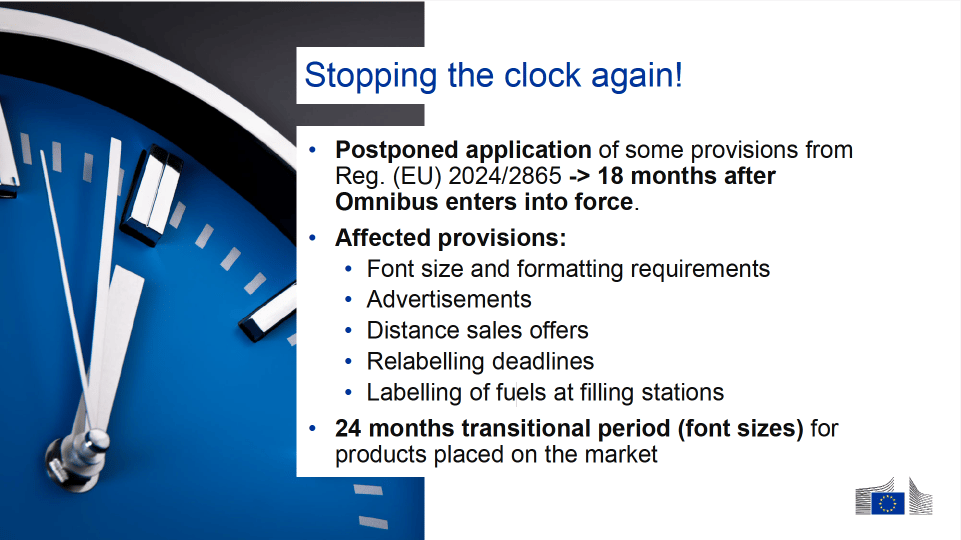
After this announcement, we had some more news on the issue.
A big thank you to Monica Hodgkinson of WD-40 who sent through the result of Tuesday 14th July’s vote which saw the proposals accepted at parliamentary committee level, see https://www.europarl.europa.eu/cmsdata/309107/2026-07-14%20CJ45%20vote.pdf (and hat tip to Steven Brennan of Foresight who had spotted that this vote was due to happen).
Although this is progress, I understand that the final vote in plenary, that is the whole of the EU parliament, is not due until week commencing 19th October.
As usual, I would be very careful around this issue until we have the actual legislation published on EUR-Lex, in case there are any last-minute changes.
Urban Wastewater Treatment Directive consequences
Steven Brennan also notes on LinkedIn that:
“The EU’s revised Urban Wastewater Treatment Directive is becoming a live test of extended producer responsibility.
Not in theory.
In legislation, litigation and lobbying. Under the revised UWWTD, producers of medicinal products and cosmetic products must cover at least 80% of the cost of quaternary treatment to remove micropollutants from urban wastewater. Industry groups are now pushing back hard.”
More details here: https://www.linkedin.com/posts/dr-steven-brennan_wastewater-regulatory-monitoring-activity-7472349659693293569-heGG.
Jan Robinson notes that this post on the Urban Waste Water Treatment Directive UWWTD appears to pre-date the EP resolution, so here is the link to the latter if anyone needs it: https://www.europarl.europa.eu/doceo/document/TA-10-2026-0228_EN.html
Many thanks to Jan and Steven for keeping us up to date with this are, which I predict is going to cause problems for EU businesses for some time.
It’s difficult to see how this will work in practice unless these costs are passed onto the consumer.
A worrying example of how PPWR will work in practice
Speaking of how things work in practice, an excellent (and scary) update from Steven Brennan on how PPWR will actually work in the real world: https://www.useforesight.io/labs/the-life-of-a-package .
“One bottle carries 37 verified obligations across seven components, ten handovers and five regulatory clocks. Your portfolio is not one bottle“.
I think that simply describing PPWR as “red tape” is to understate the sheer volume of unnecessary work which is being dumped on industry, it’s death by a thousand pieces of red tape.
Around the World
POPs proposals
ICYMI (and I had certainly missed this), Phil Rowley has spotted that there are two new proposed Persistent Organic Pollutants (POPs) which will be discussed at the next meeting of the Stockholm Convention in September.
The proposed chemicals are:
- Decabromodiphenylethane (DBDPE) and its related substance 1,1′-ethane-1,2-diylbisbenzene, brominated
- Bis(2-ethylhexyl) tetrabromophthalate (TBPH), including its individual isomers and combinations thereof
There are more details in this post by Kei Ohno Woodall, who is Senior Coordination Officer at Basel, Rotterdam & Stockholm Conventions: https://www.linkedin.com/posts/kei-ohno_proposals-list-stockholmconvention-share-7469690764608864256-J5IF/
Process Safety Corner
Recent incidents:
- 1 dead, several injured in naphtha pipeline fire, suspected theft from pipeline may be involved https://www.linkedin.com/posts/bakrmammar_haldiafire-westbengal-breakingnews-ugcPost-7478145764184158208-XErp
- Ammonium nitrate explosion after a road traffic accident in China, 2 dead and 4 injured: https://www.linkedin.com/posts/bakrmammar_ammoniumnitrate-hazmattransport-chemicalsafety-ugcPost-7479588313033699328-qnAl/
- There has also been a suspected ammonium nitrate explosion here in the UK, luckily no deaths: https://www.thefpa.co.uk/fire-and-risk-management-journal/news/major-fire-and-explosion-at-essex-farm
- 5 dead in “empty” fuel barge explosion in Paraguay https://www.linkedin.com/posts/bakrmammar_processsafety-majorhazards-marinesafety-ugcPost-7479228708172513280-OU0v/ .
- A fire on a partially demolished oil storage tank in Wales, probably caused by sludge igniting (no causalties): https://www.linkedin.com/posts/bakrmammar_safeprocess-processsafety-majorhazards-ugcPost-7481061674637160448-GOz2/
Insights:
The “empty” fuel barge explosion in Paraguay, and the tank fire in Wales, reminded me of something which seems like a paradox, which is that an empty flammable container can be more hazardous than a full one. This is because the most severe hazard is from a vapour explosion, not from a flammable liquid fire, and the more empty the vessel, the more space for vapour.
When you also consider the risks of anoxia, toxic fumes etc, I think we should always look at “empty” tanks and vessels with a great deal of suspicion, and be particularly aware of dense or light vapours which may give misleading readings on gas sensors. And it’s definitely not enough just to have a detector for eg flammable or toxic gases, it should also always include oxygen concentration.
There few things as alarming as hearing the sensor go off when you are supervising drainage crew on a chemical site, with a man down a 10 foot deep manhole (and yes, that is the voice of experience! Luckily the chap was retrieved very quickly, but it was a very anxious moment all round).
Infographic of the Month
An excellent infographic on trust by Tanmay Vora (and his experiences are very useful too): https://www.linkedin.com/posts/tnvora_sketchnote-share-7473271785254199296-G8sJ/
The Weekend Watch/ Read
A hilarious post from Ashley Quigley on his recent “Tin foil Tuesday” post https://www.linkedin.com/posts/ashley-quigley-cchem-mrsc-78a41a157_happy-tin-foil-tuesday-i-have-spent-my-share-7482724925724766208-yAo-/
Another one to show to your chemophobic friends and relations, but only if they have a sense of humour…
The Weekend Recipe
With all the lovely weather, it has been frustrating not to have the occasional ice cream (thank you, lactose intolerance!), so I have finally purchased an ice cream maker from Cuisinart. Time for a culinary experiment!
I have made some changes to their “normal” recipe to take into account the facts that (a) Arla’s lactose free cream is like whipping cream, not double cream, with a fat content of only 35% compared to 48%; and (b) the sugar needs to be reduced in the lactose free version to take into account the fact that lactose free products are about twice as sweet as regular milk products. (You can take the girl out of the lab, but you can’t take the lab out of the girl…).
Vanilla ice cream in the ice cream maker
For most ice cream makers: the night before you make the ice cream, put the bowl in the freezer (or store it in there permanently). Make sure the bowl is completely frozen before you start the mixing process.
Ingredients for full milk
This is about 1.2 litres ice cream when made, you may need to adapt the quantity if you’ve a different maker.
- 235 ml whole milk ( – which is 250 ml minus one tablespoon (15 ml)
- 150 g granulated sugar
- pinch of salt
- 470 ml double cream that is 500 ml minus two tablespoons
- 1 tablespoon pure vanilla extract
Ingredients for Lactose Free vanilla ice cream
- 450 ml Arla lactose free cream
- 115 g granulated sugar
- pinch of salt
- 2 teaspoons (1 dessertspoon or 10 ml) pure vanilla extract
Method, normal milk products: In a large bowl, whisk the milk sugar and salt together until the sugar is dissolved . Hand or electric whisk is fine. Then stir in the double cream and vanilla using a spoon (to avoid air bubbles forming). Cover and store in the fridge for 1 to 2 hours or overnight.
Method: lactose free products: place the cream, sugar, vanilla extract and salt in a large glass or other microwave-proof bowl. Stir in the sugar with a wooden spoon. If the sugar won’t dissolve, heat the ingredients together gently in 1 minute bursts in the microwave until it does dissolve. Cool the liquid down (use a water bath if you’re impatient, I filled my washing up bowl with cold water and pop the bowl in there for 15 minutes or so), then cover and store in the fridge for 1 to 2 hours or overnight.
To make the ice cream from the mixture (both product types): In the case of the Cuisinart, you then assemble to maker and switch it on, then pour in the cool creamy mixture, and let it mix for “about 15 to 20 minutes”. Eat immediately, or store in the freezer for a firmer texture.
Findings: This does make a nice vanilla ice cream, in both cases. I think I might try reducing the sugar content in both versions a little bit, to allow the cream flavour to come forward more, but overall, well worthwhile.
Reasons to be Cheerful
in July, we had some Very British Problems:
- Freezers https://www.youtube.com/shorts/7T-mQkDBeBs
- Food packaging https://www.youtube.com/shorts/iFzP17W_ono
- Car parking https://www.youtube.com/shorts/e9TMvpVGEFQ
- Airport https://www.youtube.com/shorts/pSrASMEnCcw
- Live chat https://www.youtube.com/shorts/WDmc-Nqonws
Many thanks for reading this LinkedIn newsletter, and many thanks to everyone who has contributed, through sending in links, queries, comments etc. If you have anything you’d like to share, please email me or send a DM, and I’ll do my best to include it in the next Chemicals Coffee Time Monthly.
It would be great if you’d like to subscribe to this newsletter on LinkedIn if you haven’t already, and if you want to get the news early, and much, much more (because we can’t include everything in this monthly round-up), you can sign up to our weekly email newsletter here: https://chemicalscoffeetime.co.uk/. (This website includes the email archive, with both open-access and subscriber-only content).
Chemicals Coffee Time Monthly and Weekly have grown over time to support the chemical industry, and are free to read and free from adverts. If you’d like to support our work, why not treat yourself to one of our new Chemicals Coffee Time mugs? https://chemicalscoffeetime.co.uk/product-range-mug/ .
Look forward to chatting to you in late August or early September.
Kind regards,
Janet
Janet Greenwood, TT Environmental Ltd
PS We’re happy for you to use this content in your own social media or newsletters, as long as you credit Chemicals Coffee Time. Please note that this newsletter highlights issues which may be of interest to your business, but is not intended as specific advice. We always recommend that you should do your own research. If you need consultancy help, please book a Quick Consultancy Call here: (https://chemicalscoffeetime.co.uk/quick-consultancy-calls/), or Quick Consultancy Email here: https://chemicalscoffeetime.co.uk/quick-consultancy-emails/
- You can sign up to the weekly Chemicals Coffee Time email here: https://chemicalscoffeetime.co.uk/.
- Our live online training courses CLP Fastrak and CLP Mastery will be running again in September and October respectively, see https://clpmastery.com/, (nearly) everything you need for classification, SDSs and chemical Regulatory Affairs in the UK and EU
- The “main” consultancy website is https://ttenvironmental.co.uk/ (Environmental/ IPPC Permit and COMAH)
- Not forgetting the Chemical Regulations Self Help Group website at https://www.chemselfhelp.co.uk/